KOREV /Evidence/ 01

Specialized agents & business workflows

Hand the work to AI. Keep the decision.

Evidence turns your business processes into workflows of specialized agents, designed around your rules, your flows, and your enterprise's knowledge. The agents take on the operational work; your experts keep the approvals and the decisions that matter.

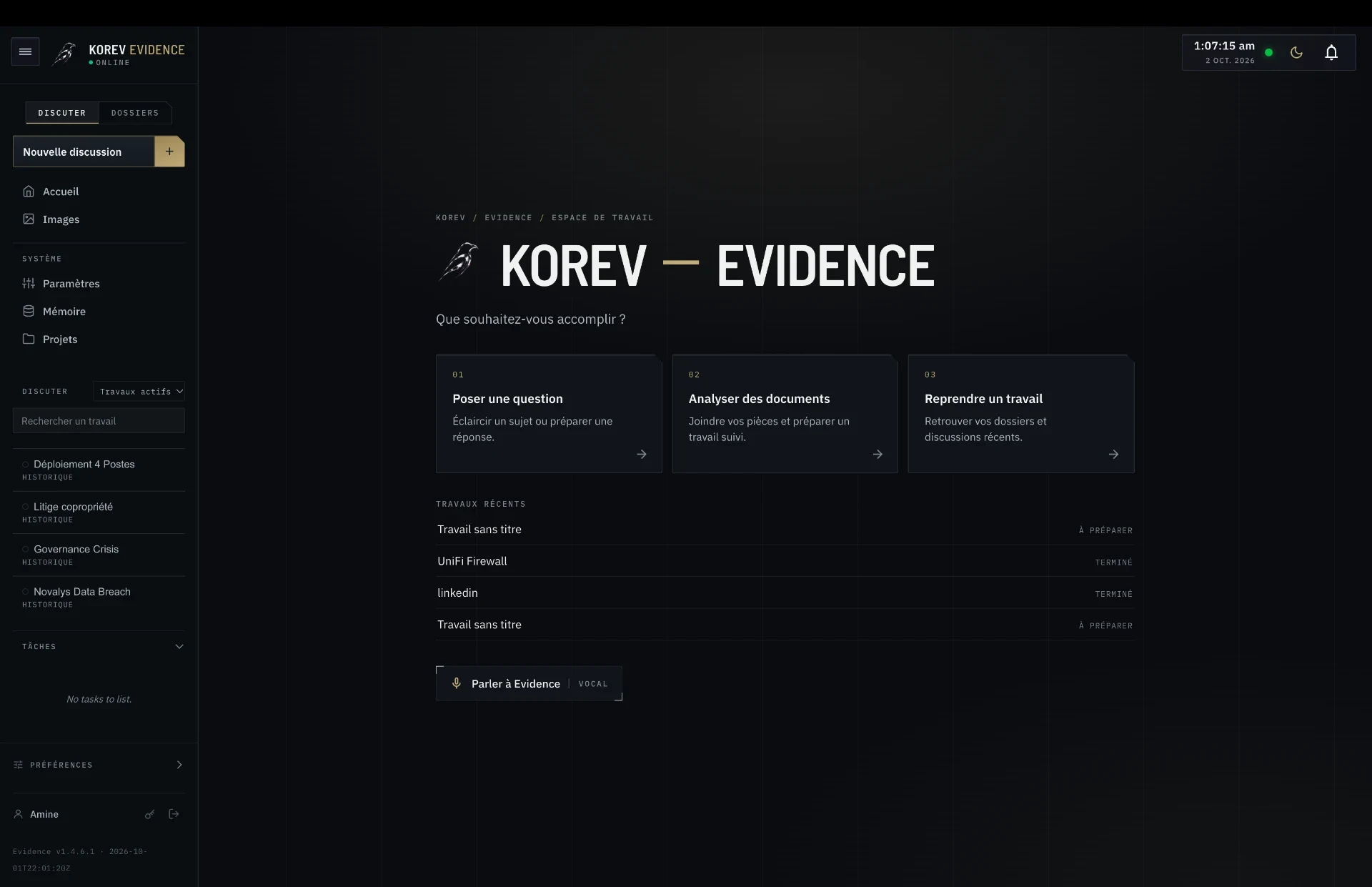
Evidence / WorkspaceReal screenshots · Demo
Real screenshot of the KOREV Evidence home screen

One space to start, resume, and track the work.

Ask a question, analyze documents, or pick up a case: each piece of work keeps its context and its status.

Where it fits in the architecture

  1. Evidence — agents and orchestration
  2. PRISM — control and approval
  3. Atlas — Enterprise LLM and reasoning

AI no longer just answers your experts. It works with them — under control.

The problem

The processes that matter don't fit in a prompt.

Reviewing a case file, checking compliance, preparing a recommendation, classifying an incident, assessing a supplier: this work draws on several areas of expertise, internal rules, and approval points. A generic assistant knows neither your process, nor your rules, nor your responsibilities.

  1. 01A real process chains together steps, roles, rules, and knowledge specific to the organization.
  2. 02A single raw answer does not account for the contradictions, gaps, or uncertainties in the work.
  3. 03The result must be directly usable by the business, not merely plausible on the surface.
  4. 04The organization must be able to review what was consulted, cross-checked, and approved — and by whom.

Use

How Evidence is specialized for your enterprise.

Specialization does not come from a library of agents: it comes from the way your organization actually works, in five stages.

Understand the process

Evidence maps the steps, responsibilities, rules, and information the work requires.

Design the agents around the business

Each agent is given a precise role based on the real flow: analyze, verify, research, challenge, prepare, or check.

Give agents the enterprise context

Agents work with the knowledge, procedures, reference frameworks, and authorized data relevant to their mission.

Orchestrate their work

Evidence coordinates the agents according to the workflow steps and the rules defined by the organization.

Keep humans in the loop where it counts

Human approvals and arbitration are placed where they truly create value or where accountability requires them.

Business outcome

What the enterprise gets.

  • A growing share of operational work handled by agents designed for your process
  • Expert time focused on judgment and decisions rather than on gathering and formatting
  • Contradictions, gaps, and uncertainties flagged before the decision, not after
  • Results your teams can use directly, structured to your standards
  • Human approval placed at the steps where the process requires it, without unnecessary friction
  • The ability to review and audit what was consulted, cross-checked, and approved

How it works

From defined work to usable results.

Six stages, adapted to your process. Agents work in parallel when it helps; the expert steps in where they add the most value.

Step 01 / 06

The work is defined

Steps, responsibilities, rules, expected result

Specialization

Agents specialized for your enterprise, not for a generic demo.

Evidence starts from your business flows to define each agent's role: what it must understand, the information it can draw on, the actions it can prepare, the rules it must follow, and the situations it must hand over to a human.

Your business flows
define the agents.
Your knowledge
gives them context.
Evidence
orchestrates their work.
Your experts
keep the decision.
  1. 01Business flowsThe actual steps of the process, as the organization carries them out.
  2. 02RolesExisting human responsibilities, used to define what each agent takes on.
  3. 03RulesThe procedures, policies, and approval points the work must follow.
  4. 04KnowledgeThe reference frameworks, documents, and authorized data the task needs.
  5. 05Specialized agentsA precise role, defined access, explicit limits, and the situations to hand over to a human.
  6. 06Evidence workflowAgents work together, your experts approve, and the result is delivered.

Interface

A space where your teams track the agents' work.

Real screenshots from the demo environment: the home screen, the summary, the analysis, the risks, and the audit of a case.

Evidence / WorkspaceReal screenshots · Demo
Real screenshot of the KOREV Evidence home screen

One space to start, resume, and track the work.

Ask a question, analyze documents, or pick up a case: each piece of work keeps its context and its status.

Operational architecture

What happens beneath the workflow.

For technical readers: the specialized agents run the workflow, draw on Atlas for context and business understanding, and call on PRISM critical control only when the criticality of the processing requires it.

A case or request enters Evidence, where specialized agents run the workflow and draw on Atlas for context, knowledge, and business reasoning. The processing can then be assessed for criticality. The standard path continues the workflow directly; when a critical control is required, PRISM is brought in before processing returns to Evidence. Human approvals take place at the steps defined by the process, then Evidence delivers the output along with the elements intended for its review.

Flow view: ordinary flows progress directly; only processing classified as critical brings in the PRISM engine.

Input·Case or process
DocumentsDataRequestReference frameworks
Evidence Workspace
Cases · Agents · Workflows
Operational coordinationActive workflow

Specialized agents

The agents coordinate the investigation and production steps according to the role defined by the process.

AnalyzeDocuments & data
ResearchCorpora & precedents
Cross-checkInconsistencies & gaps
ProduceSummaries & deliverables
Continuous exchange
Intelligence drawn onCross-cutting capability

Atlas

Atlas provides the understanding of enterprise context and the reasoning engine that inform each of the agents' actions.

ContextReference frameworksKnowledgeReasoning
Criticality assessment

Based on the process and the policy

The workflow can assess a processing task to determine whether reinforced critical control is required.

Direct branchStandard flow

Standard path

The workflow continues without systematic multi-model cross-checking. Routine searches, document analyses, and summaries progress directly in the workspace.

Continuous progressNo added decision overhead
Conditional branchConditional

Critical control

· PRISM

Brought in when the stakes call for multi-model cross-checking and a strict policy before delivery. Processing that commits the organization is thus subject to independent verification.

Critical Cognitive EngineUnderstand critical control
Both paths rejoin the Evidence workflow
Business governance

Process approvals

At the steps defined by the business

Checkpoints and approval points placed according to the workflow's requirements (before commitment, before release, or at a sensitive milestone). The decision stays within the remit of the authorized owners.

Finalized deliverable

Evidence delivery
Direct result

Summary, report, or expert memo that business teams can use directly.

Cited sources

Outputs designed to be sourced can return the references and passages used, for review.

Checks & trace

Trace according to the workflow: agent log and approvals. An integrity artifact may be issued for critical outputs subject to the applicable policy.

Operational ruleNot all processing requires PRISM · Human intervention follows the process milestones

Engineering & proof

Capabilities backed by a documented test and orchestration suite.

Technical claims about Evidence rest on documented measurements and artifacts, presented with their methodological limits.

Documented mechanismDocumented

14

Documented agent profiles

14 active profiles under agents/: compliance, contradictor, default, developer, finance, hacker, infrastructure, legal_drafting_guarded, legal_safe, marketing, medical, multitask, researcher, sales. The _example folder is excluded.

Limit: Refers to profiles configured in the Evidence orchestrator, not to 14 distinct AIs or proprietary models.

Documented mechanismDocumented · 2026-09-17

5 required checks

Controlled production deployment chain

Production release chain for the Evidence backend: protected main branch, mandatory PR, 5 required checks, enforce_admins, build/deploy guardrails, drain before restart, /healthz, and VERSION.json.build_commit.

Limit: Proves deployment discipline and release traceability; it is neither a measured SLA, nor a security certification, nor proof that no incident has occurred.

Offers

From a first proven process to regulated deployment.

The journey always starts with a real business process. All offers are on quote after scoping; details are on the Deploy KOREV page.

Evidence Pilot

On quote

Prove out Evidence on a real business process.

  • 1 targeted business process
  • Real or representative data
  • Specialized agents designed around the flow
  • Defined rules and approvals
  • Success criteria set before kickoff
  • Working demonstration and value measurement
Test Evidence on one of your processes

Evidence Production

On quote

Scale one or more business workflows.

  • One or more workflows in production
  • Integration with existing business applications
  • Gradual extension to new processes
  • Monitoring, training, and support
Scope a production rollout

Evidence Regulated / Enterprise

On quote

Deploy in a sovereign or regulated setting.

  • Sovereignty and private environments
  • Regulatory requirements and governance
  • Reinforced PRISM control on critical work
  • Atlas within your perimeter
  • Extended auditability and traceability
Talk architecture with KOREV

Architecture

Evidence operates, Atlas understands, PRISM secures what is critical.

Evidence is the operational layer: this is where your teams work with the specialized agents. The agents rely on Atlas to interpret enterprise context and knowledge. When processing reaches the level of criticality defined by the policy, PRISM takes over to cross-check several independent models and suspend processing when the criteria set by the critical policy are not met. Evidence delivers the result with its sources, its checks, and, for critical outputs that go through the relevant finalization pipeline, an integrity artifact.
Evidence organizes the workflow and interacts with Atlas for context and reasoning. After the criticality assessment, processing either follows the standard path or branches to PRISM when critical control is required. The result then returns to Evidence.

Input · Case file or business process
Cognitive coordinationContinuous context & reasoning exchange
Evidence calls on Atlas to contextualize every action
Criticality assessment

Routing by process and policy

The workflow can classify processing by its sensitivity and the applicable policy in order to adjust the level of control.

Standard path
Direct processing

Searches, information summaries, and routine analyses run directly, without systematically triggering multi-model control.

Direct, smooth execution
Delivery in Evidence

Result · Sources · Required approvals

Deliverables are returned to the operational workspace with their justifications and the configured human review points.

Operational workspace

Evidence

Operational Intelligence Interface

The workspace where teams use KOREV agents to handle case files, follow the workflow, and deliver the outputs.

Key attributes:
Specialized agents
Case files under review
Business workflows
Sourced deliverables
Cross-cutting framework · Built into the architecture:
  • Human oversight
  • Sources & trace
  • Governance
  • Data control

Capabilities

Evidence platform capabilities.

Agent workflows on your processes

A unified environment to define, run, and monitor workflows of specialized agents: analysis, research, checking, comparison, synthesis, recommendation.

Agents designed around your organization

Each agent's role, access, responsibilities, and limits are defined according to your flows, your rules, and your knowledge. A framework of 14 documented profiles serves as an engineering foundation, not a fixed catalog.

Enterprise context through Atlas

Internal procedures, reference frameworks, and corpora are drawn on for the agents' understanding, without blind raw injection into the weights.

Control level matched to the stakes

The workflow assesses the criticality of a processing task to determine whether reinforced control is required before delivery.

Detection of gaps and contradictions

Inconsistencies and missing information are explicitly flagged before any conclusion.

Built-in human approval

Approval points are placed at the steps where the business process requires them; the expert stays in charge of the decision.

Sourced, reviewable results

Outputs designed to be sourced retain the passages and reference frameworks used, allowing rigorous review.

Integrity of critical outputs

For critical outputs that go through the relevant finalization pipeline, an integrity artifact can be issued according to the applicable policy.

Integration with business applications

Connection to the sources and tools defined at deployment: DMS, ERP, CRM, internal databases, APIs.

Governance

Governance and operational traceability.

Evidence retains the elements the organization needs to account for every processing task: sources, agents involved, checks, and approvals.

Regulatory compliance depends on the context, the system, its use, and the organization's role. KOREV provides technical governance capabilities; on its own, it does not constitute a legal certification of compliance.

  • Sources and passages linked to the conclusions
  • Identification of the agent profiles and versions used
  • Verification results and detected inconsistencies
  • Timestamped human approvals attributed to experts
  • Integrity artifact for critical outputs that go through the relevant finalization pipeline
  • Reviewable audit trail for internal reviews and third-party audits

Deployment

In the environment you define.

Evidence runs where the organization decides. The agents rely on Atlas to understand the business context, within the chosen isolation perimeter.

European cloud

Hosting under European jurisdiction, fast setup, strict data isolation.

Hybrid

Data and internal knowledge stay with you; orchestration and models are distributed according to the sensitivity of the processing.

On-premises

Platform, agents, Atlas reasoning engine, and data in your infrastructure. No mandatory external dependency.

Use cases

Where organizations use Evidence.

Industry

  • Nonconformity analysis
  • Technical documentation
  • Supplier qualification
  • Search across procedures
See the sector FR

Healthcare / MedTech

  • Regulatory files
  • Quality control
  • Sector monitoring
  • Preparing summaries
See the sector FR

Finance / Insurance

  • Compliance and controls
  • Complex credit files
  • Internal policies
  • Regulatory analysis
See the sector FR

Legal / Public sector

  • Search across official corpora
  • Analysis of exhibits and case files
  • Sourced memos and submissions
  • Source checking
See the sector FR

Which process would you hand over to agents?

Describe it in a few lines. We assess its sensitivity, its approvals, and its deployment level, then propose an Evidence Pilot scope.

KOREV — AI that shows its work.

Frequently asked questions about Evidence